Pg 08a L4
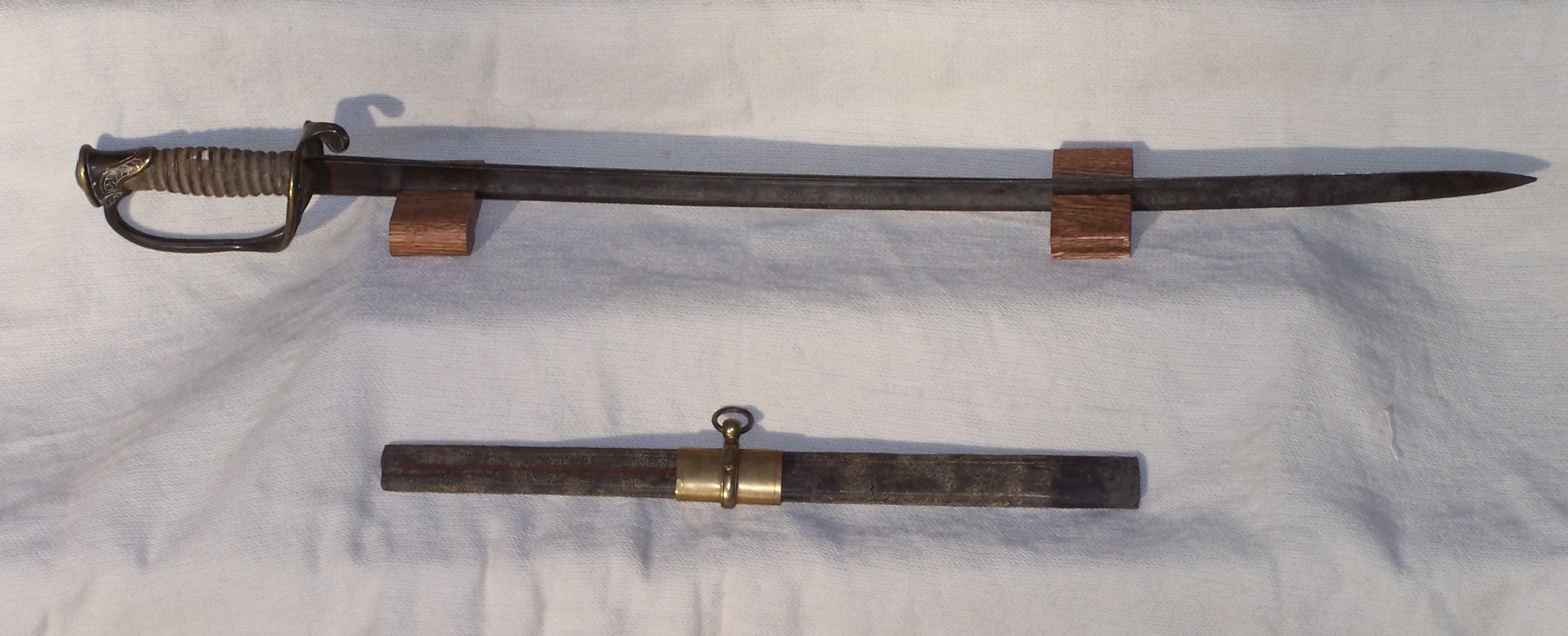
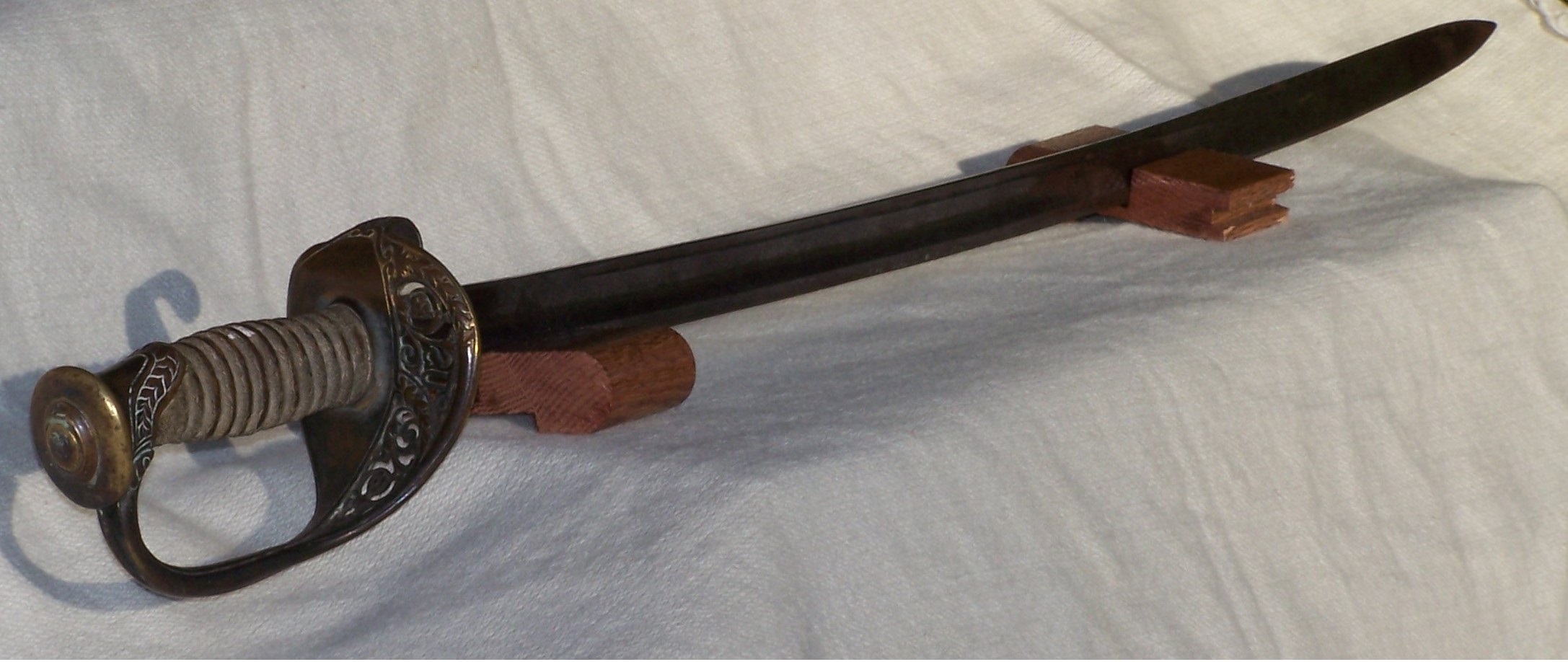

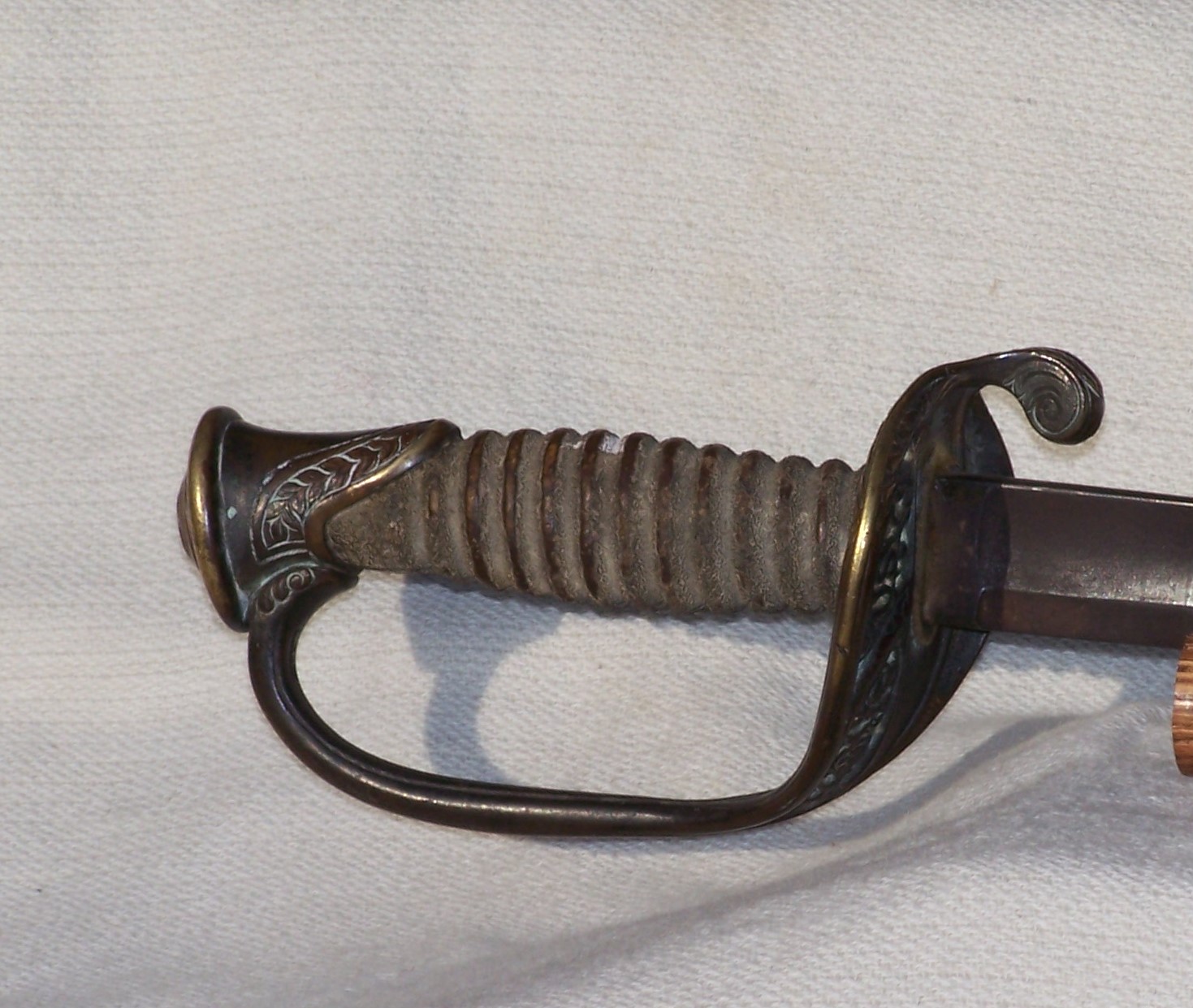


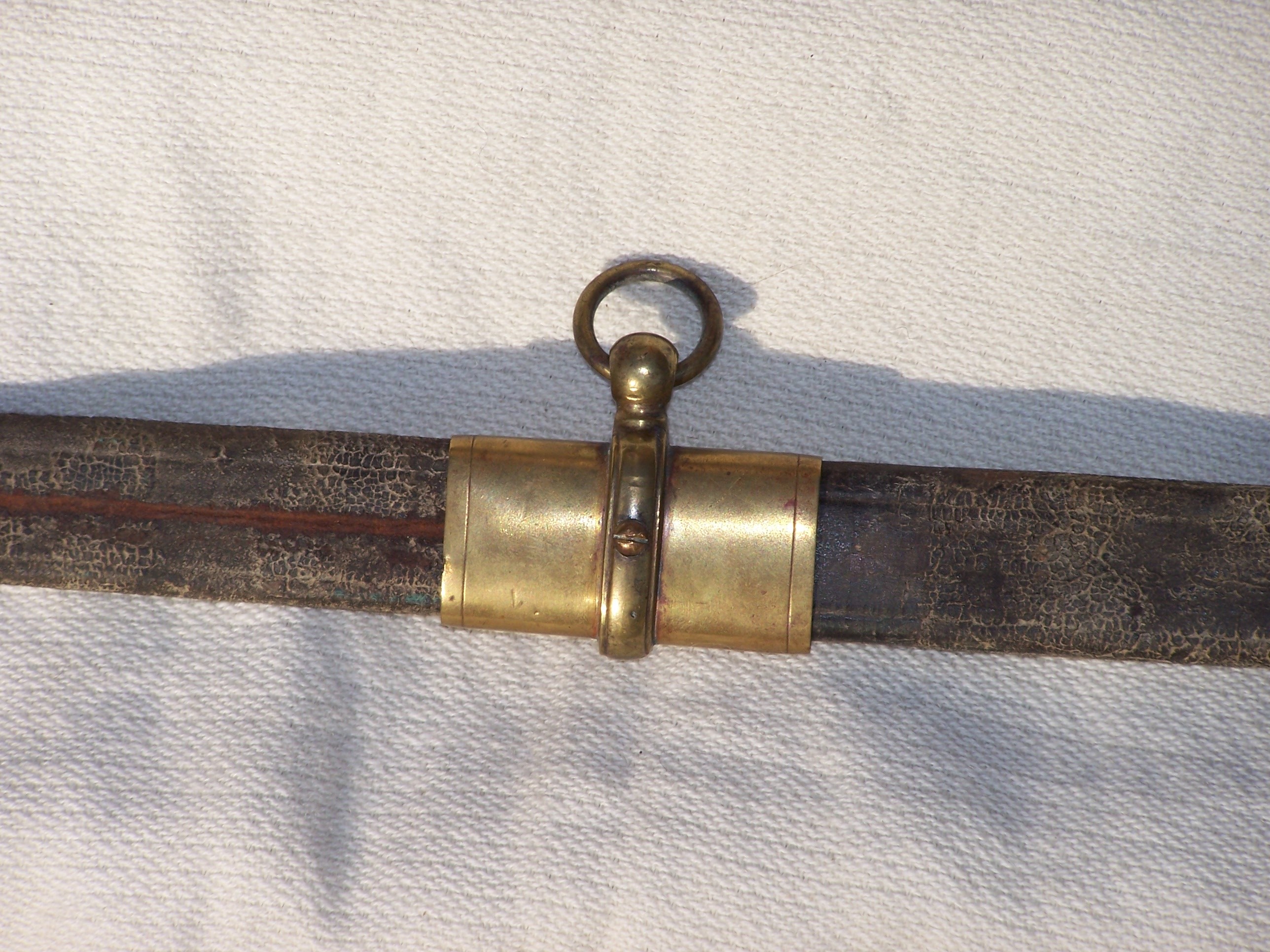
The above photos are of John Darwin Shepard Cook's Sword he received when he became a commission officer.
The story that follows is his experience with this sword as well as a second sword he obtained on the battlefield.
Story of the Sword
A True Narrative Connected with the War of the States
|
By Bishop Philip Cook, Wilmington Delaware, 1934
|
In 1861 a young man, recently graduated from the Albany Law School after completing his
academic course at Union college, helped to organize a Company of soldiers to enter the
conflict as part of the Union Army and as a commissioned officer was presented with a
sword. Following the war this same officer, now married, established his family in
Kansas City of which the writer was the youngest of four children.
In the largest unfinished third floor or attic of my boyhood home, this sword was a chief
treasure. It was attached to its heavy leather belt with a large brass buckle stamped with
the insignia of the Union. It came to have an important part in any of the games in which
we might engage on rainy days in the large playroom this part of the old house furnished
us. He who wore it might be Commander of the Army, Pirate Chief, Jesse James with his
gang, or any other position of leadership our children's imagination in play might
assign him.
Second only in importance to this sword, was a belt, once worn by a Confederate officer,
always assigned to the leader of the opposition. There was usually a contest between
my brother and myself as to which of us should wear the Union sword and belt, but as he
was older and bigger, the result was mostly in his favor.
In the course of time, I came to appreciate with deepening interest my father's account
of how the belt of a Confederate Colonel came into his possession. At the Battle of
Gettysburg the Twentieth New York Militia, in which he commanded a Company, occupied a
position in the Union line behind a stone fence. His description of his experience there
included a vivid account of the horrific artillery fire to which the Union force was just
before Pickett's charge began its attack. This cannonade continued for close unto half an
hour with a fury unparalleled in his years of experience in the war. He told how he
waited there, immediately behind the man of his Company, revolver in hand, alert to
check by threat or force any move that might result in retreat or panic. For it was
submitted to a most grueling test of endurance. There protection was meager, the
cannonade as crushing as the Confederate artillery could make it, and there was
nothing to do but to take the punishment as the groans and shrieks of men wounded
and dying mingled with the roar of opposing guns and bursting shells......
Then followed Pickett's famous charge. The guns ceased and the familiar "Rebel yell"
was taken up by thousands of men.
The moment had come for the infantry of the Union line to resist the attack and in
the excitement of action the tension was broken. On swept the charge directed at
this particular point in the line as its center. But it failed to reach its objective.
Only a remnant survived to cross the field of death and only a few of those who took
part in that magnificent, futile effort reached the Union line.
Pretty complete exhaustion overtook both armies before the sinking sun brought on respite
of night and firing ceased. During the hours of darkness the Union soldiers had to be
content with such rest and sleep as the battlefield itself afforded and only such food
as their knapsacks could furnish. All along the line the wounded were sought and
cared for during the hours of night. In the minds of the men in ranks there was no
assurance as to which Army could claim victory, doubt as to what the marrow might
bring forth. Most of them were too worn and exhausted much to care. What they desired
was water, food, and sleep, most of all sleep.
When, later, General Lee withdrew his Army from the field, a great sense of relief came
to the tired Union combatants, their spirits revived and, released from danger of
immediate attack, the routine life of an Army in the field was reestablished.
One of the first orders given was that commanding officers should provide for the
burying of the dead. The Captain of Company I, Eightieth New York Militia, appointed
a detail of soldiers to bury those in that part of the line and he personally supervised
their work. Of the Confederate dead, fifteen were found immediately in front of their
position, all privates saved one officer, a Colonel. His name was written in his cap
and an identification card found in his pocket. His sword had been shattered by a bullet
and his belt loosed in raising his body, was handed to this Captain. Under his direction,
a large trench was prepared and the bodies laid side by side in this grave, but the body
of the Colonel placed at the head of the trench in a place by itself.
Captain Cook had been reared a Congregationalist, but before entering the Army had
equipped himself with a copy of the book of Common Prayer of the Episcopal Church.
This he now used, and there, on the Gettysburg Field, read the Office of the Burial
of the Dead before the grave was filled. The souls of the men they had shot down,
men who were seeking to destroy them, were committed to the mercy of God in the words
of that service. The Confederate soldiers and their commanding officer began their
long sleep of the grave a blessing from the lips of their enemy. They were warring
sons of the one God.
The belt, he kept.
Thirty years passed.
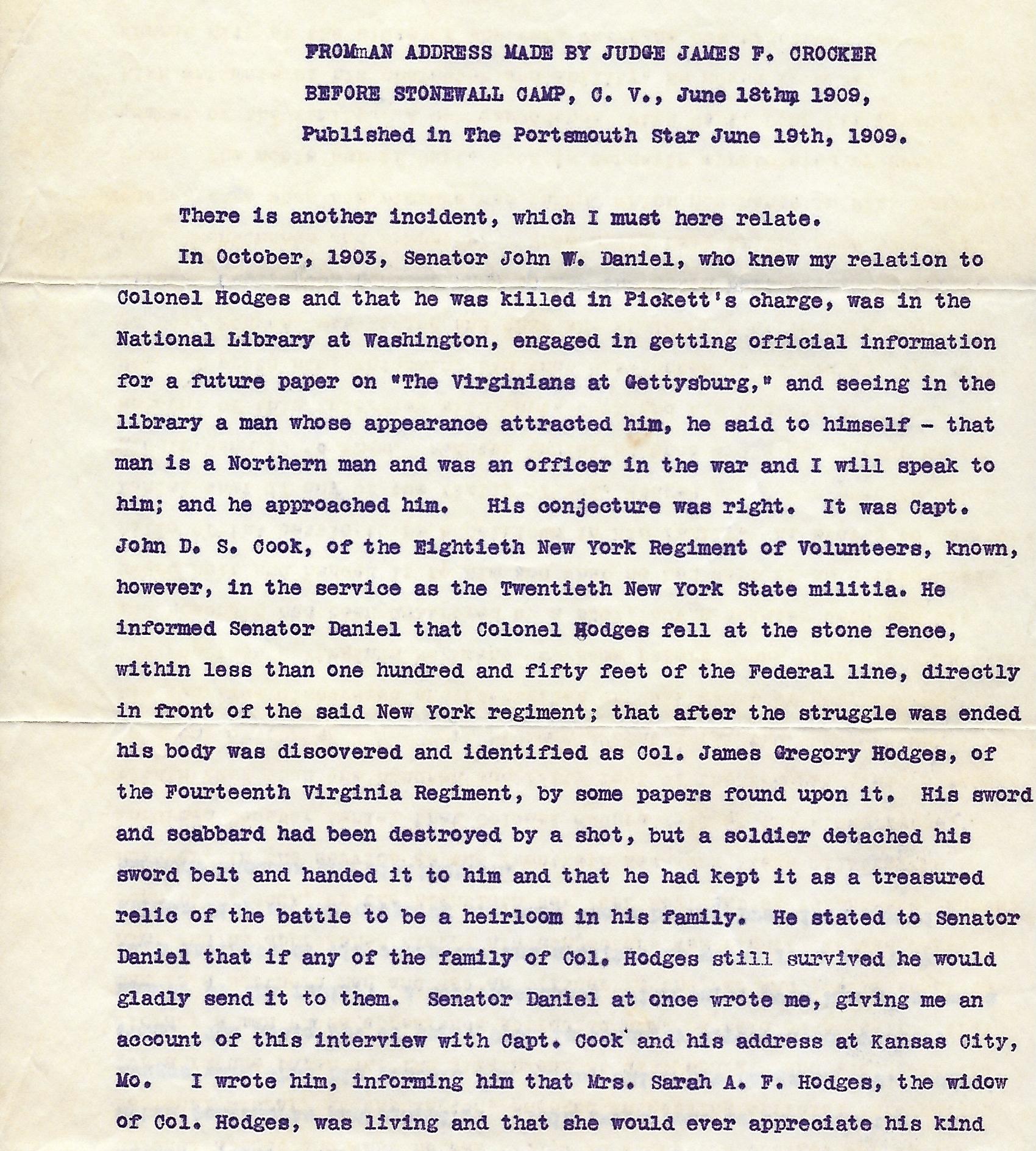
Judge James F. Crocker tells what became of that Confederate belt, so familiar to my
boyhood, and this is quoted from a paper read by him at the Stonewall Camp of Confederate
Veterans, July 18 1909.
There is another incident which I must relate here.
In October, 1903, Senator John W. Danial, who knew my relation to Col. Hodges and that
he was killed in Pickett's Charge, was in the National Library at Washington, engaged in
getting official information for a future paper on "Virginians at Gettysburg" and seeing
in the library a man whose appearance attracted him, he said to himself, that man is a
Northern man and an officer in the war, and I shall speak to him, and he approached him.
His conjecture was right. It was Captain John S. Cook, of the Eightieth New York regiment
of Volunteers, known, however, in the service as the Twentieth New York State Militia.
He informed Senator Danial that Col. Hodges fell at the stone fence within less than a
hundred and fifty feet of the Federal line, directly in front of the said
New York Regiment, that after the struggle was ended his body was discovered and
identified as Col. James Gregory Hodges of the Twentieth Virginia Regiment by some
papers found on it. His sword and scabbard had been destroyed by a shot, but a soldier
detached his sword belt and handed it to him and that he had kept it as a treasured
relic of the battle and to be an heirloom in his family. He stated to Senator Danial
that if any of the family of Colonel Hodges still survived he would gladly send it to
them. Senator Danial at once wrote me, giving me an account of this interview with
Captain Cook and his address in Kansas City, Missouri. I wrote him, informing him that
Mrs. Sarah A.F.Hodges, the widow of Colonel Hodges, was living and that she would ever
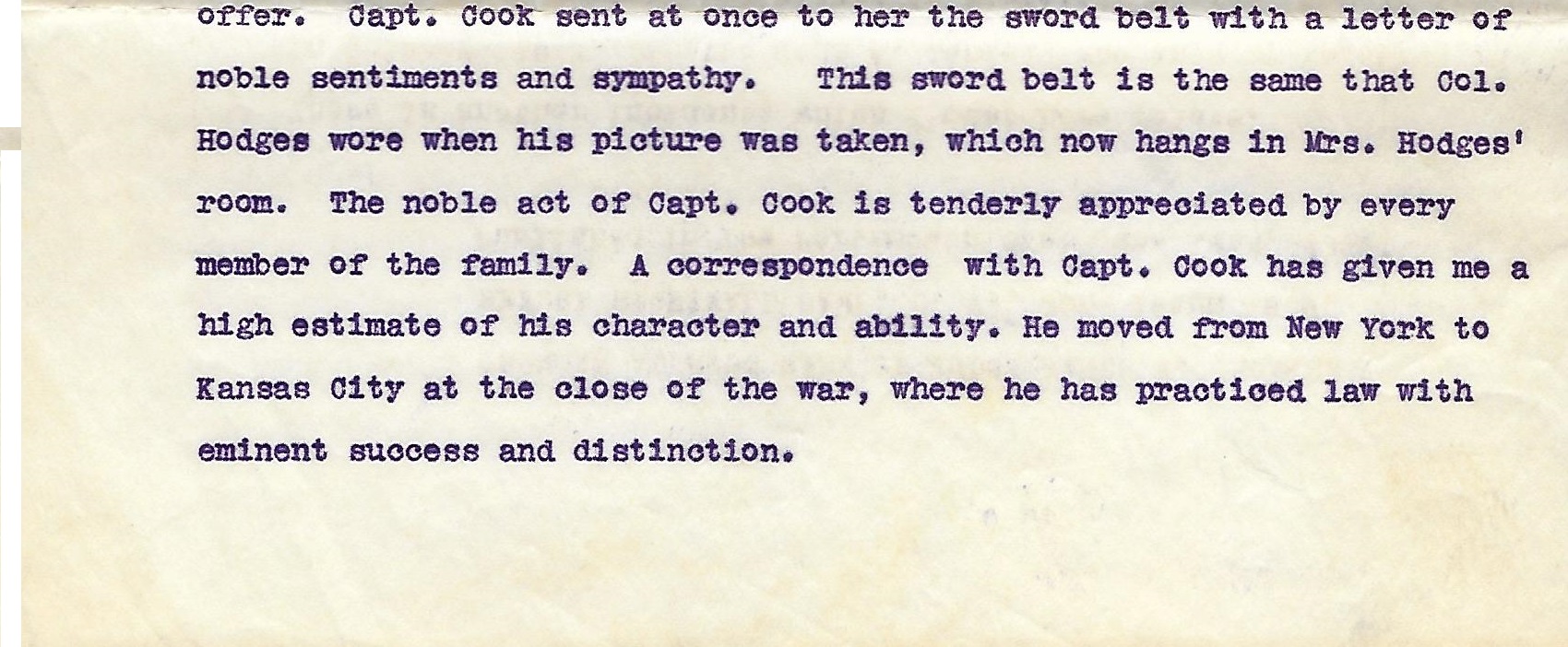
appreciate his kind offer. Captain Cook sent at once to her the sword belt with a
letter of noble sentiments and sympathy. The sword belt is the same that Colonel Hodges
wore when his picture was taken which now hinges in Mrs. Hodges' room. The Noble act of
Captain Cook is tenderly appreciated by every member of the family. A correspondence
with Captain Cook has given me a high estimate of his character and ability. He moved
from New York to Kansas City at the close of the war, where he practiced law with
eminent success and distinction."
This account, carefully correct, gives little conception of the dramatic elements involved.
That happen-chance meeting of these two veterans was one of more than ordinary interest,
for Senator Danial of Virginia had lost a leg in his service for the Confederate cause
and rose to distinction as the representative of his State in the senate. Their talk
must have ranged over the different battles in which they had been present on opposing
sides, and in connection with his search for information about "Virginians at Gettysburg"
he was furnished with a first hand and detailed statement about the death and burial of
Colonel Hodges.
But even far more interesting were the letters exchanged by Captain Cook and the widow
of Colonel Hodges. After nearly a third of a century she heard for the first time
definite news as to the manner of his death and place of burial. After a period of a
third of a century, through information furnished, she had a satisfaction of making a
pilgrimage to the field of Gettysburg and a visit to the spot where her soldier
husband was buried. A worn and battered leather of silence, she came to know the story
in full detail.
Another quarter of a century passed. Seventy years after the battle, the Captain, in
his turn, answered to the toll-call of God.
Meanwhile the sword that had been his was lost. The family moved from the old house and
in the confusion of moving the sword was forgotten. A later search revealed the fact that
our old playroom, and the walls lathed and plastered. Somewhere, perhaps tucked away in
the rafters, the old sword and belt were concealed, but no one knew where.
In Kansas city there is an antique shop where old furniture, old silver, odds and ends of
various shorts are bought and sold. One day, in 1934, an old negro presented himself with
a long package under his arm which he carefully unrolled and timidly offered for sale to
the antique dealer. The depression had come; times were hard; the man needed money. It was
a sword in the battered scabbard, broken at the end so that the sharp point stuck out like
a toe through the hole in a boot. He had found it, he explained, in clearing up the cellar
of a house being prepared for a new tenant.
The shop dealer bought it and at once communicated with the former law partner of
Captain Cook, who in turn secured it to restore it to the family.
The Captain's grandsons have listened to the story with shinning eyes and handled the old
scabbard and felt the point of the sword with reverent touch, for on the brass of the
scabbard is plainly discernable the inscription; Presented to J.D.S. Cook, Kington,
October 21st, 1861.
Here is a letter from Judge Crooker pertaining to the return of the sword to the widow.
Link to John Darwin Shepard Cook(08), pg 08a
| |