The Sinking of the Oronsa
|
These two letters were written by Philip Cook (09) after a Trans Atlantic Crossing in 1918
during WWI.
|
pg 09d L3
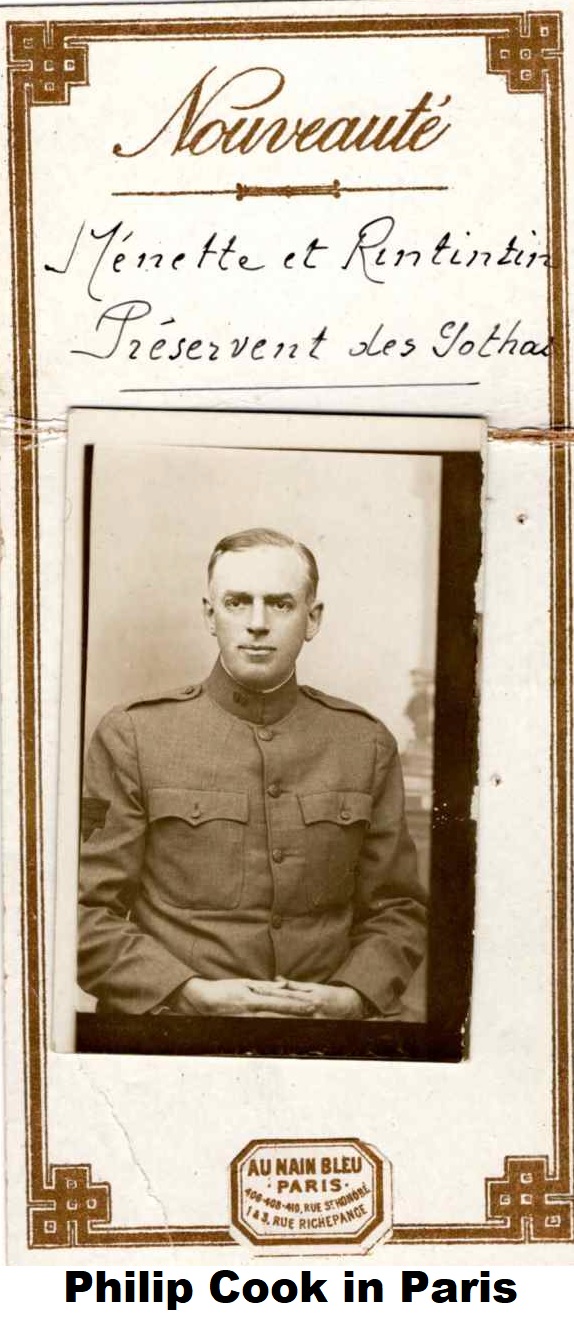
April 30th 1918
The Lieutenant-Commander was right. He sailed in the ship with the YMCA party and except for
the time we were accompanied by a naval ship with superior officer, he was acting Commodore
of our convoy of ships. Second day out, while in the smoking room he remarked, "We
embarked on a Friday, sailed on the thirteenth of the month. There are thirteen ships in the
convoy and thirteen parsons in this group of YMCA men - and I don't see how we can hope to
bring this ship safely to port". He was right. We didn't.
But our luck held up to the last night of the journey. In many ways it was a fine crossing.
The going was slow and some days the sea rough and the roll of the ship heavy - but of our
group of fifty seven, that constituted the YMCA party, only a few were sea sick for any
length of time.
Though the time was long it did not hang heavy on our hands. For the men of our party there
were daily classes in French, modern History, and instruction in Camp Work at the front. For
the last we were fortunate in having with us Mr. Henry Holmes of Australia and South
Africa, who has had more than two years experience in hut work among the British forces on
the Western front and had been making a tour of America. He was a man of high intelligence
and strong personality with the gift of telling the story of his experiences in a way that
is full of interest as well as valuable information. It proved a strange journey for him and
his American wife - for they had been married only a few weeks before and this journey was
really their honeymoon. For him the trip was only another thrilling experience added top
the many he has met in his journey from South Africa to France and his work there. His
bride was one of the five women aboard and lost her trousseau.
For us the day began with setting up exercises, which was supplemented by military drill in
the afternoon. One of the parties who had been in charge of the physical training of the
New York police force gave instructions in boxing to those of us who wanted them.
Every evening we had a short devotion service, and after we had been out a few days some sort
of concert or entertainment. The men who were going out as entertainers were anxious to show
what they could do. The Captain gave us the run of the ship - and from head steward to ship
carpenter they all helped to furnish properties and costumes, that made it possible to
present entertainment quite remarkable on the high seas.
There were fifty seven in the American party and some sort of the newspaper men published a
little eight page paper called the Mid Ocean Pickle, setting forth the virtues of the fifty
seven varieties. It was published too early to deal with the real pickle in which we found
ourselves.
The party was in charge of Author E. Hungerford, formerly connected with the Baltimore Sun
and now handling Public Works of the American YMCA. His management of affairs was of a very
high order both before and especially during the moments of real peril when men were
summoned to the life boats. During the trip he maintained a good sprit of discipline among
the men but with such tact and common sense that no one chafed under it. The drilling and
marching the daily inspection of rooms with special reference to the placing of life belts
and hand torches, the same advice given from time to time among all counted in our favor
when the sudden call came and the lights of the ship went out.
The journey was a little enough like the usual trans Atlantic crossing. We had left port
with least possible notice. We handled our own baggage, made up our bunks and kept them neat
and trim. Some of the party by special arrangement took the place of the table stewards and
served the others meals. Their work was heavy and required four or five hours a day for which
they were paid.
We had men in the party who came from States extending from New England to the Pacific Coast.
Besides the parsons there were businessmen, physical directors, newspapermen, schoolteachers,
professional entertainers and a few regular workers in the YMCA in the States. Within a few
days, we had become a well united family. The men were cheerful but serious in intent. At one
time they would appear like a group of light hearted College men off on a spree, and again
with eager interest they would listen to the description of the kind of work expected of them
in a hut at the front. They could join in a very creditable but ridiculous minstrel show
and again enter with a very real devotion in a religious service.
They had been impressed with the greatness of the work before them and how greatly they were
needed. No man could listen to Harry Holmes without learning that much - and every man was
keen to make himself as much prepared and efficient as possible.
And so the days passed until the last night we expected to be on board. For two or
three nights previous some of the men had brought pillows and blankets and slept in the
saloon but with a light house blinking from the shore way off in the distance, most of
them went to bed after the minstrel show with an unusual sense of security and in the
conviction that the greatest danger had passed.
Then the unexpected happened - but I reserve that for a letter by itself.
(signed) Philip Cook (09)
|
The Night the Oronsa Sank, May 1st 1918
|
The Sinking of a Ship
In describing such an event as the sinking of a ship, one can do best to relate his own
experience.
After the minstrel show on Saturday night the men walked on deck for a while before going to
their rooms. For two days the sea had been so smooth as to have almost the appearance of oil.
It had been moon light with a slight haze - and still the moon light held through a slight
breeze had raised a ripple on the floor of the sea.
I had been asked to conduct a Communion Service the following morning before the men left
the ship and went to my room rather earlier than usual. A thud that shook the ship throughout
its length roused me not completely that I was out of my bunk almost before opening my eyes.
My room mate was out almost as soon. The thud had been so muffled that it seemed almost impossible that
anything very serious had happened - but even as we pulled on our high boots the rapid ringing of the ship's bell
sounded the alarm.
Our room was situated in a corridor at the aft end of which was a bulk head iron door
which was closed at night and we had been warned that in case of danger, the one at the
other end would be closed at the earliest moment. The one dread I had was the trap - so
when Hungerford's voice sounded down the corridor "Hurry up, men, they are going to
close this door " I reached with one hand for coat, sweater and overcoat that hung on
one hook, and with the other for my life belt and hurried up the corridor. Men were coming
up the passages from every part of the ship - on up the companion way, out on the
promenade, and up again to the top deck and Captain's cabin which hung the boat to which I
was assigned. Here I stopped to put on sweater, coat and life belt and look about. Half
clad figures were hastening to the several boats swiftly but without confusion. The men
from forcastle and second cabins with even fewer clothes - mostly barefooted and dressed
in trousers and undershirt - came in greater agitation and more our of breath because they
had further to go. Despite the mist it was light enough to see other ships off in the
distance through they appeared dim and indistinct. Orders and shouts rang out in the night
air and the rattle of ropes in the blocks as the men prepared to lower the boats.
Suddenly all the light on the ship went out and a blast from the whistle gave the
signal- Abandon Ship.
Together with the others I sprang into a life boat even as the men began to lower it.
That journey from the top deck to water was the most trying feature of the whole experience.
To begin with, we could not find the plug that must be set in place before the boat rests
upon the water; when that was found, after what seemed like an interminable wait and put in
place the lowering of the boat was further stopped because the rope which holds it in place from the beneath had not been released.
It took a while to find a knife to cut that. Then the boat began to go down unevenly - first one
end and then the other and each time and at each slip a shout went up from those in the boat to
those in charge of the roped on deck. There was a sigh of relief when finally the boat rested on
the water and the men who had lowered it slid down to their places.
But our sense of relief was shortlived. One of our men in the boat had become entangled in
the rope so that the pull of the boat threw him into the water. Many hands reached for him
but the continued pull lifted him above us, hanging head down as the boat released at the
one end came round with a crash against the side of the ship. It seemed as though nothing
could save him - and the whole boat load was involved in his peril. One of the Y.M.C.A men
with a knife reached above the place where his foot was caught and to the surprise and joy
of all, with a comparatively small knife he severed the strands of the rope so that our man
dropped free into the boat. But our troubles were far from over.
The big ship was still under way and bearing down upon our small boat. Even after oars
had been secured and placed against the ship it was impossible to shove off. It was just
as if we were in the grip of a swift uncontrollable current - in reality the movement was
not the water but the ship. and through the effect was the same, so that we scrapped the
side of that sinking ship from a place forward of the bridge down to the very stem. We
could not get free. In one way it was fortunate that we were the last boat to leave for it
would have been impossible to keep from the under the others as they were lowered. In
another way it was very unfortunate because each boat had left its bearing blocks and
tackle swung from the davits above and into these six tangles of rope, our boat plunged
with imminent peril of being capsized. For a while it seemed as though it would be safer
to jump into the water. The fact that the ship was sinking rapidly was borne upon us by
the sight of decks already awash. How strange they seemed - those familiar decks where we
had marched and drilled - or loitered and played quoits.
|
But even as one thought of these things the stern pass us and we were free at last.
For a way we rowed strong to put some distance between us and the ship but at about two
hundred yards we stopped almost instinctively to watch. The moon was just above the horizon
and on the broad belt of light it cast upon the sea our abandoned ship appeared in silhouette,
like some great living thing in mortal agony. The stern sank deeper and deeper and the brow
rose higher and higher until her keel showed. Fire appeared in the ship itself and lit up the
scene. There was a muffled explosion and as it went down to its grave in the sea darkness
settled down on the scene.
Over in the distance a destroyer waited to receive us and toward we rowed at will. Most of the
life boats had reached its side as we joined the crowd being helped up to its low iron deck.
Here the men went from place to place greeting each other and it soon became reasonably
certain that all our party was safe. Over where the ship had gone down, to brilliant glares
marked the spot and over that place amidst wreckage and abandoned life boats, the destroyer
moved slowly looking for anyone who might be in the water. A smoke arose from the water which
we afterwards learned came from a depth bomb.
It seemed much longer but the ship sank in twelve to fourteen minutes after being struck and
we had been in the boats considerably less than an hour.
It was a motley crowed that the rising sun looked down upon there on the deck of the
destroyer - some without hats, some without shoes, some without coats or overcoats covering
pajamas. The crew and steerage fared worse than our men. There was a redistribution of
clothing - a sharing of things saved, so that except for the shower of cinders from the fast
moving destroyer non but the wounded were seriously uncomfortable.
One was proud of the behavior of our men. Not one lost his head - not one displayed any
feelings of panic. But it took little imagination to figure out what a horror it might have
been with a full quota of passengers crowding the boats, with a throng of women and children
to be cared for, or with a ship that listed as she sank in such a way as to make half her
boats useless.
There were many ridiculous things that happened - some that were tragic. Three men of our
party had expensive life suits. Partly out of envy, perhaps, they had been the butt of many
witticisms during the trip. Two of them were used but the third man appeared in an ordinary
life belt - when asked to explain he said "I forgot the darned thing". The suit he
had purchased and carried across the Atlantic had gone down with the ship.
Another was the Kodak friend. He appeared without shoes or coat but his Kodak in his hand.
Another saved only a box of cigars.
Another brought a lot of foolish junk and left his money about two hundred dollars with his
watch under his pillow.
One man had a broken arm: another a stoker who fell from the ladder, a broken leg. Another a
bad scalp wound. Three men were lost with the ship.
The shock at the stern had been terrific. A young Australian with his wife had been in a
cabin in second class. Both were hurled from their bunks against the ceiling of the cabin.
The man was wounded and the women rendered unconscious. The door of the cabin was jammed
beyond hope of opening but he dragged his wife through as a vent that had been blown in the side of his cabin.
On deck he too lost consciousness, but both were rescued from decks already
under water. The sun shone on a mostly crowed but happy one.
We came up to the dock and roused the sleeping town to the strains of
Pack up your troubles in the old Kit Bag", "The Star Spangled Banner", God Save the
King" and "Onward Christian Solders".
Custom House passed us without inquiry in to baggage - for we had none: and without
explanation of passports for even some of these were gone. We lined up on the dock in
company formation and Hungerford called the roll. When the last man had answered
"Here" to his name and involuntary "Thanks God" rose to every man's lips
and answering to the common impulse we sang the long meter Doxology.
A military man accompanied by his aids reviewed us and congratulated us on our escape. It
turned out to be none other than Field Marshal Viscount French - the Commander of British
Forces in France through the first part of the war.
After breakfast, we had short service of Thanksgiving together - and the Pilgrim Fathers
at Plymouth Rock had nothing on us in the sincerity of that service.
In the course of the morning, we boarded a train for London when the report had preceded us
and every provision made for our comfort. Red Cross supplies had been secured to provide us
with thing we needed most. The knitted woolen socks felt very comfortable after a sockless
day in heavy boots as far as my own experiences was concerned.
Coming across green England in the bright sunshine of a quiet Sunday made the experience of
the night seem unreal like an ugly night mare - but it still remains clear enough to make us
realize in grim fashion what to expect from the methods of Germany.
I got past the Cable Censor with this message - Safe, Well, happy - Acts twenty seven forty
one forty four. Look it up and see how accurate a description of St Paul's shipwreck fits our
experience.
Now it has appeared in the papers on both sides of the Atlantic and I have every hope this
letter will be released without delay.
Sincerely yours'
(signed) Philip Cook
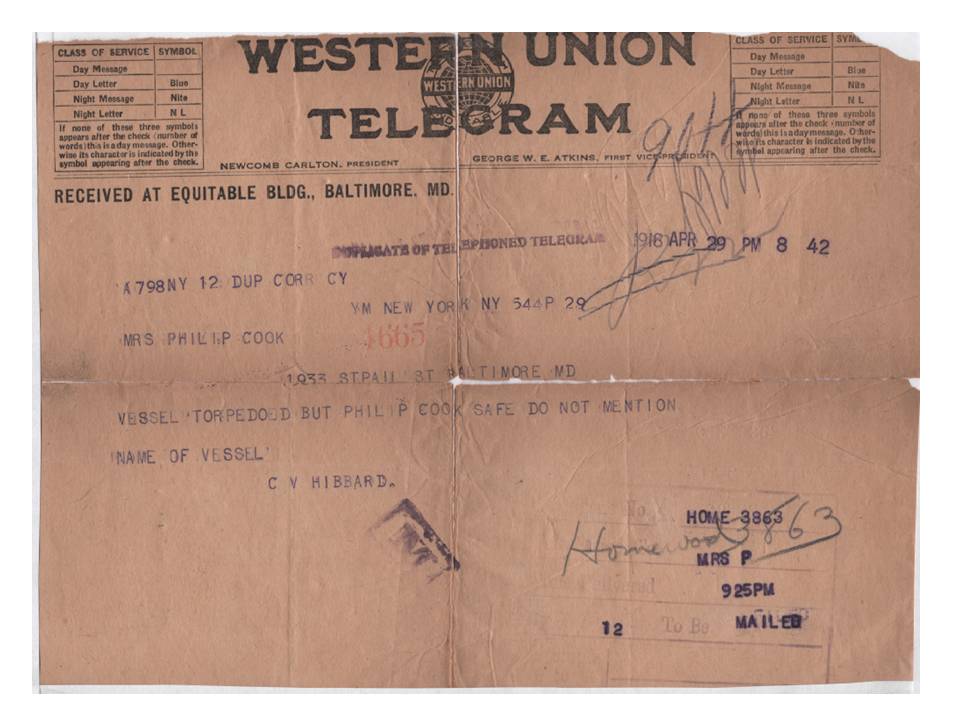
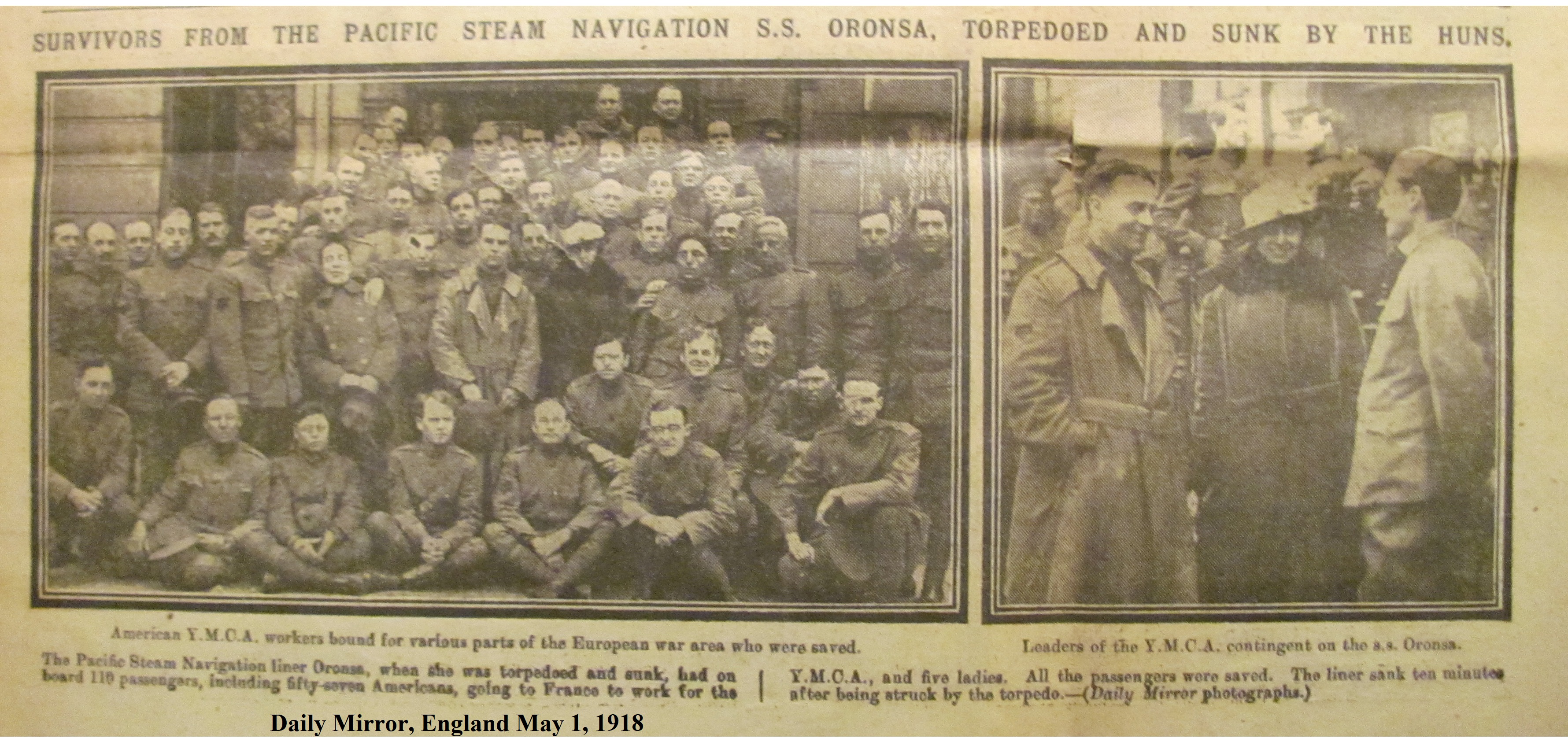
The telegram below was sent to Philip's wife Adeline informing her of the event at sea.
|
|